Discussion on Slam and Grand Slam bids.
- Pre-Screening Slam
- 2nd level control bids
- Quantitative Invite
- 3014 Roman Keycards Blackwood Convention
- Illustration of Successful Grand Slams
- Gerber
Slam investigation should start immediately after concluding that partnership has superior set of cards, collectively. Slam investigation need not wait till a game stage is reached. In fact, earlier initiation provides a convenient sign off at game level if indications are that slam is unviable.
The first assessment of Slam is based on the combined total points in partnership. The standard guidelines are
- 33 total points combined for small slam
- 37 total points combined for grand slam
However keep in mind total points are more relevant for a trump slam where voids and singletons add value.
For No Trump slam, total points largely mean HCP. Although a point or two can be added for length in suit with 5+ cards
Pre-Screening of Slam Investigation
During bidding certain triggers portend towards a good hand. If you have FIT in a trump suit, the first screening indicator (after total points as mentioned above) is losing tricks count.
In a slam worthy trump suit hand, the losing count will be 4 or less.
Opener can deduce empirically, losing trick count of responder by his point range. A FIT confirmation by responder indicates his hand strength via minimum, invitational or game force bids.
To screen slam early on, we can consider the following cases:
Case 1 – Invitational Bid
When level 1 Major bid at opening, is receiving a jump response showing invitational bid.
E.g. 1!S-3!S
Here, a Pass by opener is Sign off or 4!S is game. No further slam investigation is advised by the opener.
However, a new suit bid by opener is initiation of slam investigation. It confirms game in opener’s 1st suit and is 100% forcing (being an Alert). The order of bids in various suits is sequential and in natural order of strain (Also called Up The Line Bids). We are now showing 1st level of trick control in the that suit. i.e. presence of Ace or Void. This is called Control bid or Cue Bid.
Case 2 – Jacoby 2NT Convention
This gadget immediately confirms game in partnership. Its design has inbuilt next bid. Later bids are Cue bids for 1st trick control.
Case 3 – Slam in a Minor using Inverted Minor Raises
After confirming 3NT game in Inverted Minor Raises, repeat of the opening minor at level 4 is Slam investigation. Partnership initiates sequential Cue Bids starting at level 4. Exit by sign off is at level 5 (in case pre-screening fails).
Case 4 – Post Stayman in NT opening
Bidding other Major at level 3 by responder, after opener has relayed his major (not 2!d), confirms trump suit in relayed major and initiates slam investigation. New suit bids, next, are now Cue Bids in sequential order to show 1st level of control in bid suits.
Case 5 – Post 3NT game bid
After 3NT bid in partnership where Minors are in play. Minor suit bid by other partner is showing the suit where Slam Investigation is desired. Control Bids in sequential order to show 1st level of control, follow next. 4NT, if bid, will be 3014RKBC in the new suit bid immediately, after 3NT bid.

Directly bidding the Minor at level 5 is sign off game in Minor suit.

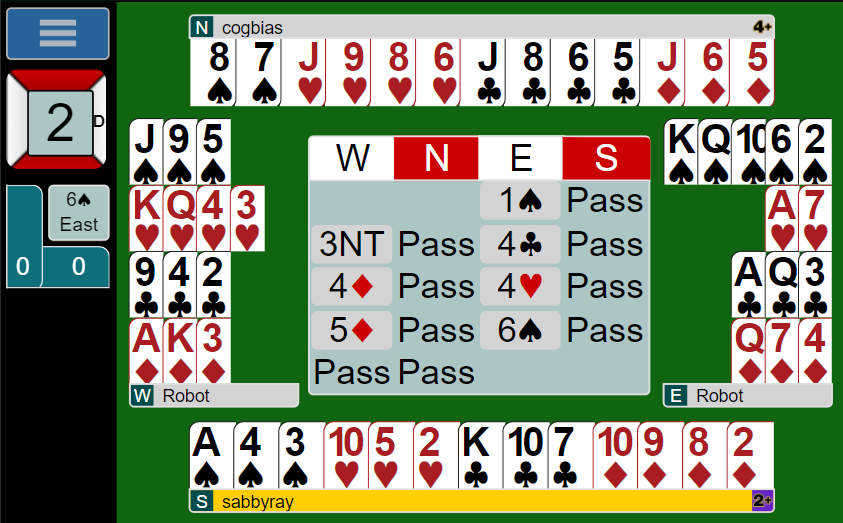
Case 6 – Slam by judgement
Control Bids or 2nd round Cue Bids
With Level 2 Cue bids, we assess if our partnership controls 1st or 2nd trick in each suit. If any suit fails this test, then the slam investigation can be terminated by signing off at game or a level below the slam.
Cue Bids are 100% forcing. Exit is available only at trump suit bids at game or a level below the slam.
Any new suit bid to initiate Cue Bids also confirms game.
The order of cue bid suits is clockwise and sequential in natural order of strain (Also called Up The Line Bids).
1st round of Cue bids show presence of Ace or Void. Repeat of the same suit a level higher shows 2nd round control i.e. Kind or Singleton.
Let’s take an example
| West | North | East | South |
| Pass | 1!H | Pass | 3!H |
| Pass | 3!S | Pass | 4!D |
| Pass | 4!H | Pass | Pass |
| Pass |
In this situation 3!h is invitational bid by South. If North concludes that slam is possible, he need not bid 4!h and instead initiate Cue Bids.
3!s bid above, confirms game and starts Slam Investigation. Shows presence of Ace Spades with North or alternatively, a void in spades to catch 1st trick in !s .
South bids 4!d confirming that he has 1st winning trick in Diamonds. Notice that he has skipped !c where he was obligated to inform his status of winning tricks (being next in line of cue bids). His skipping shows absence of top winning trick in !c in south hand.
North signs off with 4!h at game stage. He concluded after looking at his hand that even he doesn’t have either of the top 2 winning tricks in !c . so he decided to restrict the bidding to game level in !h .
Important point to note in these Cue bids is denial of control in top 2 tricks. If both partners are devoid of top 2 tricks, sign off below slam (preferably, at game) is the only solution as the slam will definitely fail.
Note : If south had winning tricks in !c , his next bid will be 4NT to initiate 3014 Roman Keycard Blackwood convention.
Slam Exploration by Quantitative 4NT
When both partners have NOT established a FIT. Quantitative invite is a bold act to dare a play in 6NT.
Here are some situations where Quantitative Invite is possible.
- On partner’s 1NT responder goes directly to 4NT
- On Jacoby Transfer or Stayman completion. Next bid of Responder is 4NT
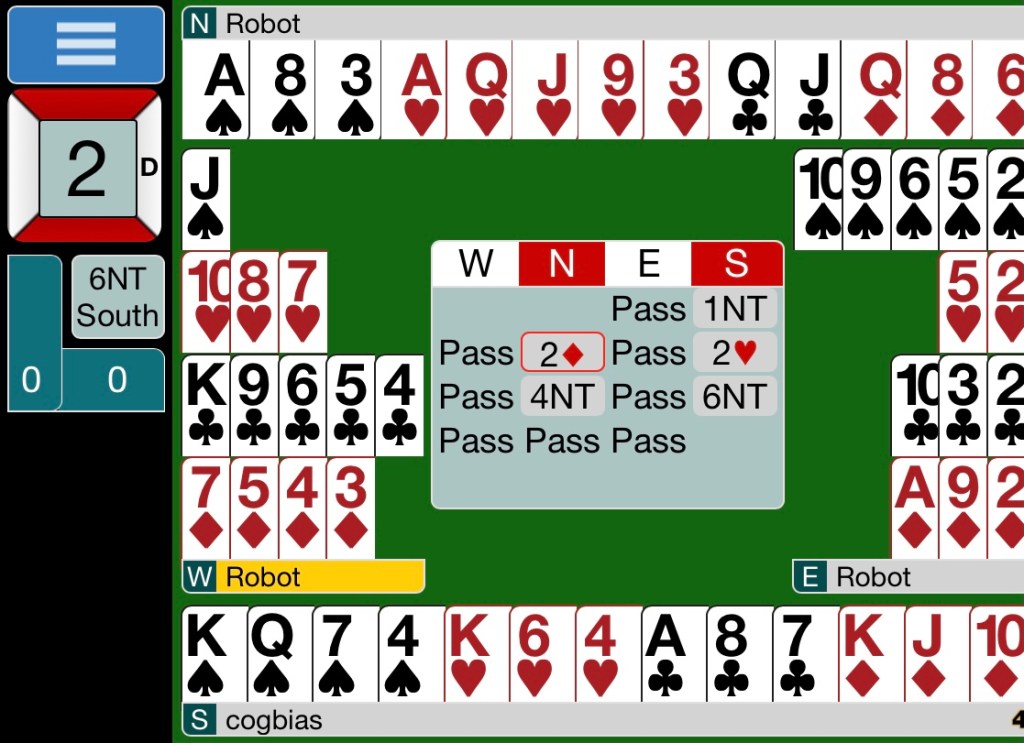
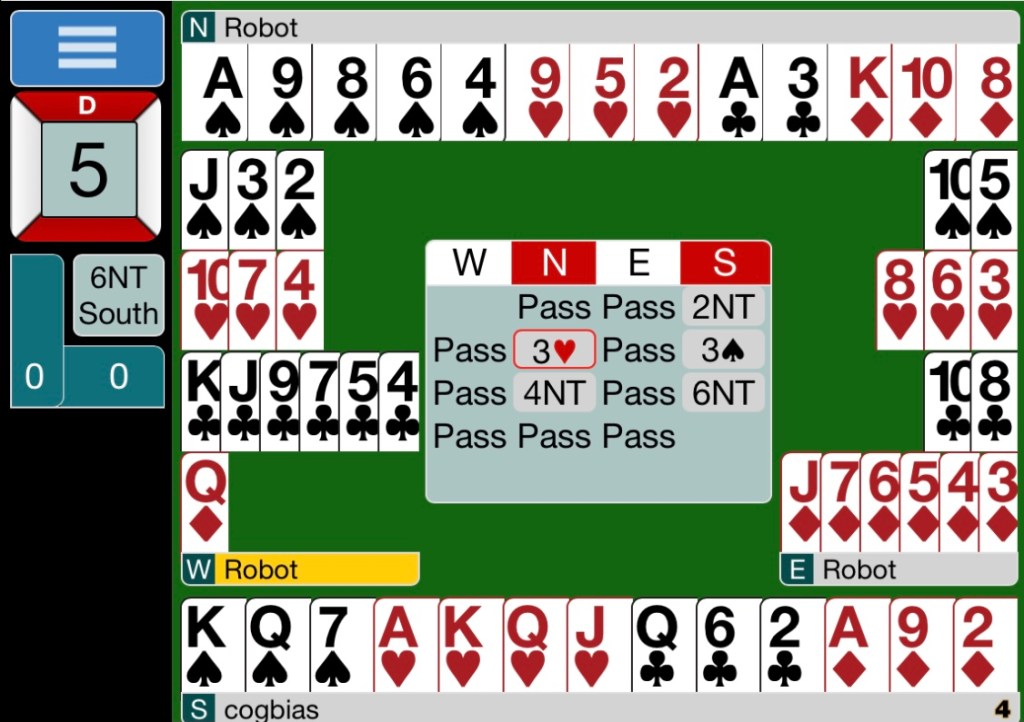
- 1!s -pass-2!H-pass-4NT in 2 over 1 game forcing but before confirming the suit fit.
- SMOLEN after failed Stayman by responder in opener’s first bid of No Trump. Opener’s 4NT next bid after SMOLEN will be quantitative because no fit is so far has been agreed.
- Reverse rebid by responder is game forcing but 4NT immediately next will be quantitative because fit has not been confirmed.
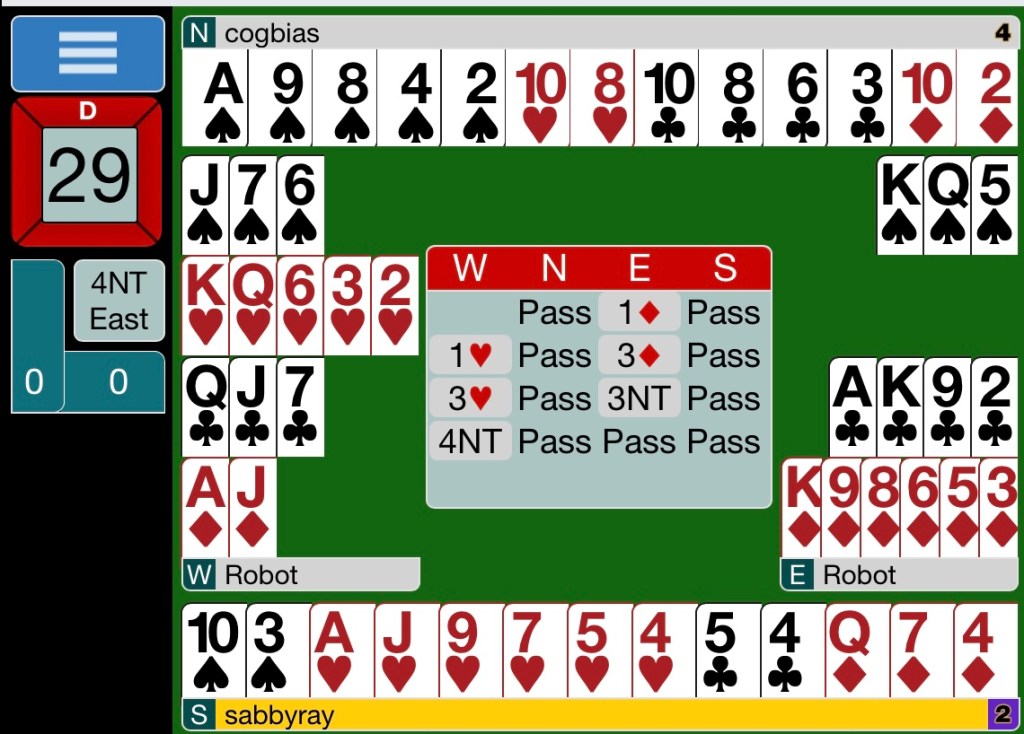
- 4NT bid over 3NT game confirmation is quantitative invite.
3014 Roman KeycardS Blackwood Convention

3014 RKBC comes into picture when we want to bid for a slam after both partners have agreed on a TRUMP suit either naturally or by inference. There are many conventions like Splinters, Texas Transfer etc.. where pre screening of slam is not possible, early on, using Cue Bids. 3014RKBC in these cases is the first step towards Slam Investigation.
One should avoid a slam unless they have all 5 Keycards or 4 Keycards+Queen of trump. A void too, becomes useful replacement of an ACE but it’s not a Keycard.
- Keycards are 4 ACES + King of TRUMP.
- Trump Queen is not a keycard but useful add-on
- Void can be a replacement of ACE but NOT a keycard
Proceed as follows :
Partner taking a call on SLAM Bids 4NT after agreement on trump suit is reached

Relay-1 : Partner bids and conveys as follows
- 5!c saying I have 0 or 3 Keycards
- 5!d saying I have 1 or 4 Keycards
- 5!h saying I Have 2 Keycards but NOT Queen of Trump
- 5!s saying I Have 2 Keycards and ALSO Queen of Trump.
- 5NT saying 2 Aces and a void
- 6 of a suit when 1 Ace and a void in the bid suit below agreed Trump strain
- 6 of Trumps when 1 Ace and a void in suit higher than Trump strain.
Last 2 options above are very confusing and can be ignored by inexperienced partnerships.
Relay-2 : Conversation moves forward with 4NT bidders next move
- Case-1 : 4NT initiator will query Queen of Trumps (only when his hand does not have it). He bids immediate next strain at level 5 but below the trump suit. In effect, it means his partner can bid slam, if he has the Trump Queen or sign off at level 5.

- Case-2 : 5NT next bid confirms all 5 keycards. Subsequent bids will disclose Kings.
- Keeping in mind Up The Line bidding principle, partnership shows Kings in specific suits at level 6 below the trump suit.
- In situations where there is no King or a King in a higher strain suit, bid 6 of the trump suit.

Note :
Most popular method to investigate slam is 3014 Roman Keycard Blackwood Convention. However RKBC is not a complete picture on slam confirmation. It only helps us in getting out of a bad slam. Factors that are more important are:
- Combined hand strength
- Choice of Trump FIT
- We may have 3 Aces in partnership, but it can also happen that the missing Ace is accompanied by the King of same suit with opposition. Cue Bids cover this risk as they show 1st and 2nd level of suit control, sequentially.
Interference via Double
opponent’s Double over all artificial conventions like 3014RKBC or Gerber, are Lead Directing. Opponent, here is requesting his partner to move opening lead in this suit.

Illustration of Successful Grand Slam BidS
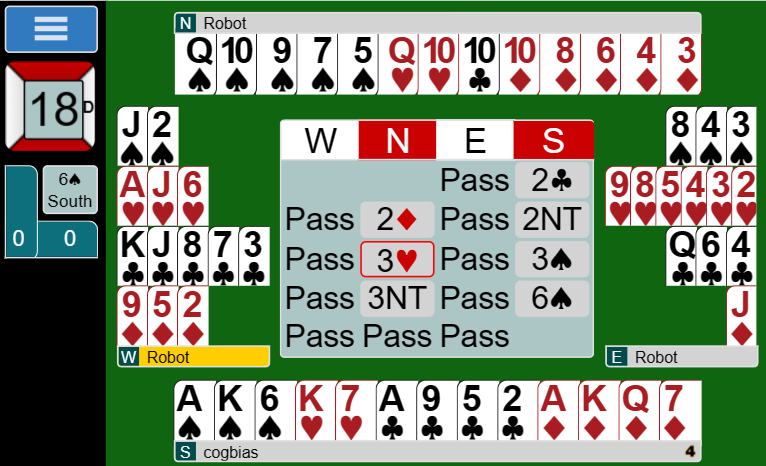
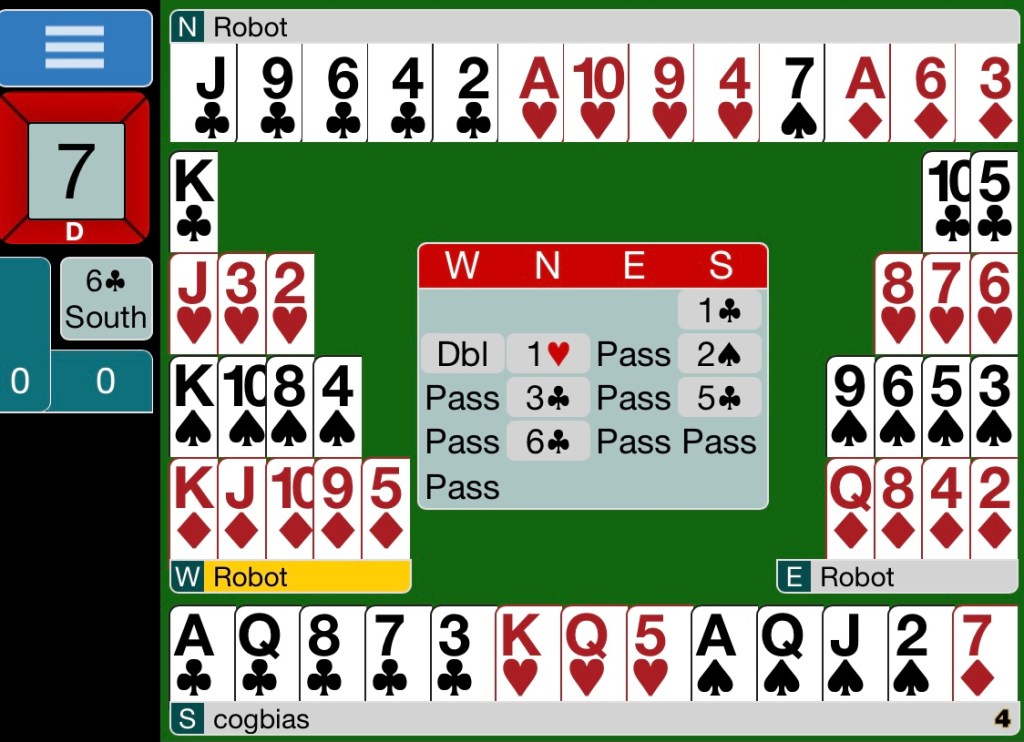
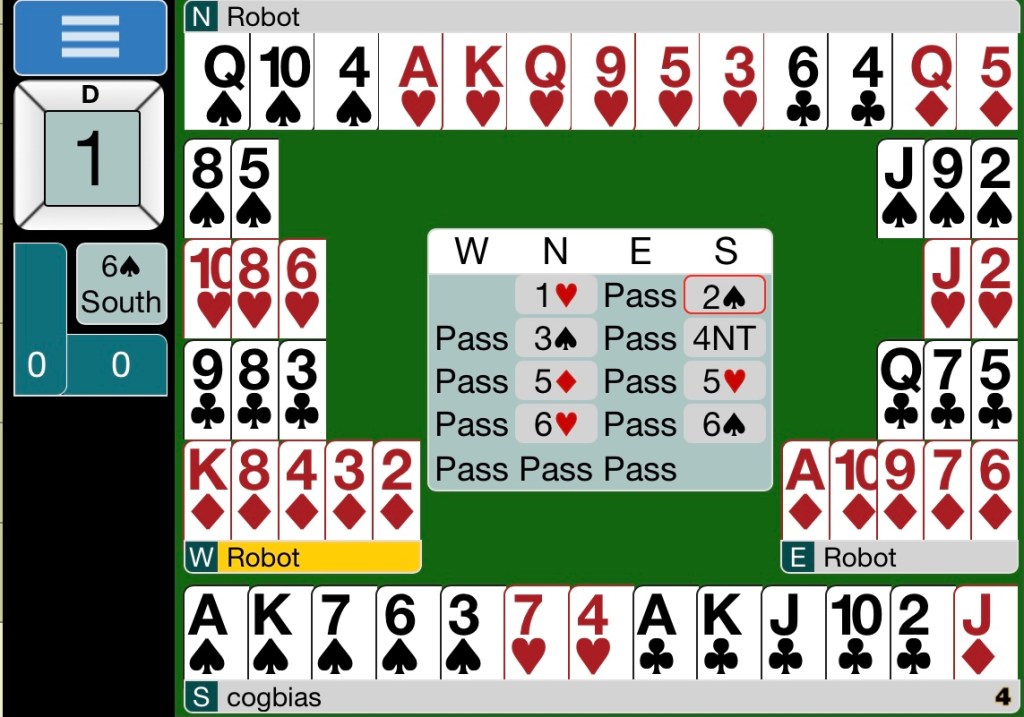
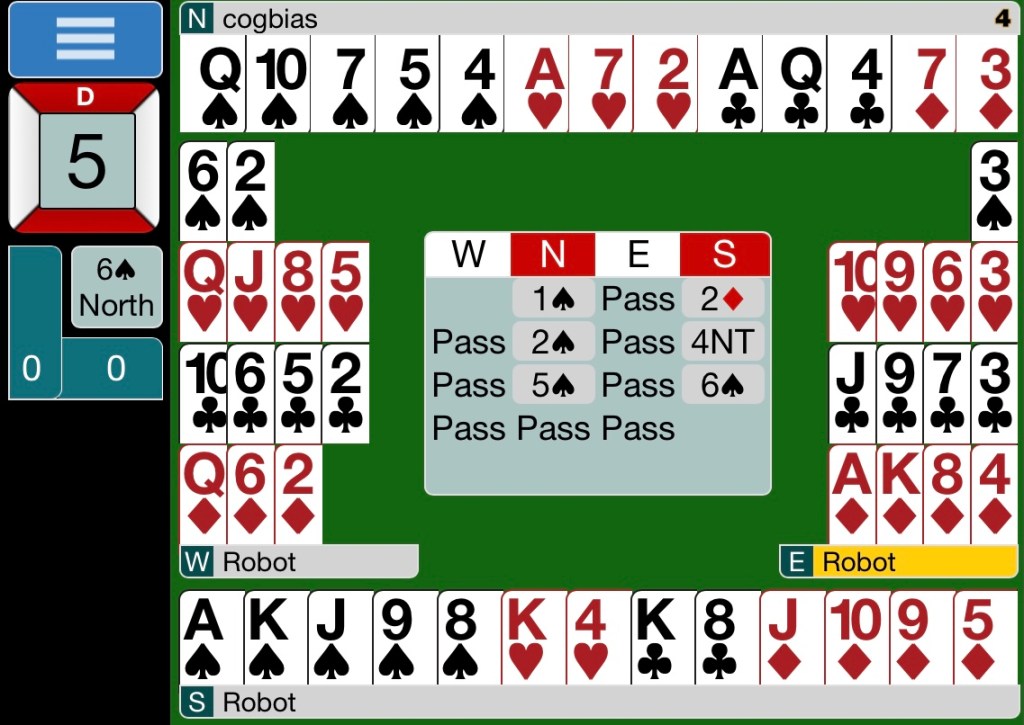
Let’s take up a detailed review of a BBO grand slam hand. The bidding is long so detailing is done in two images below.
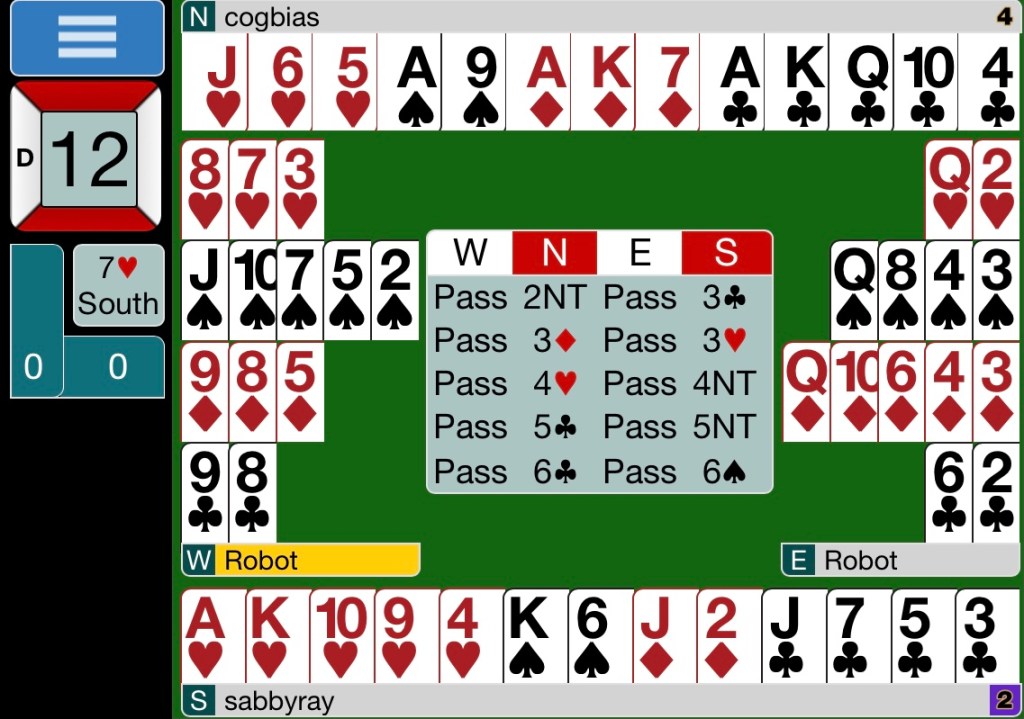
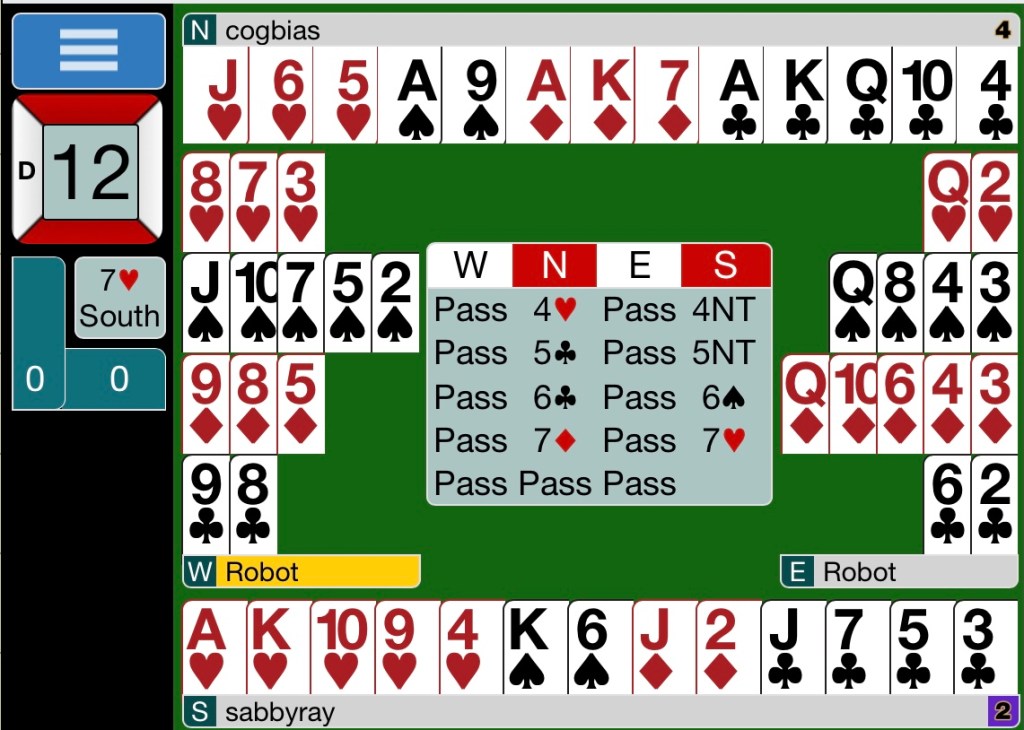
Another Grand Slam
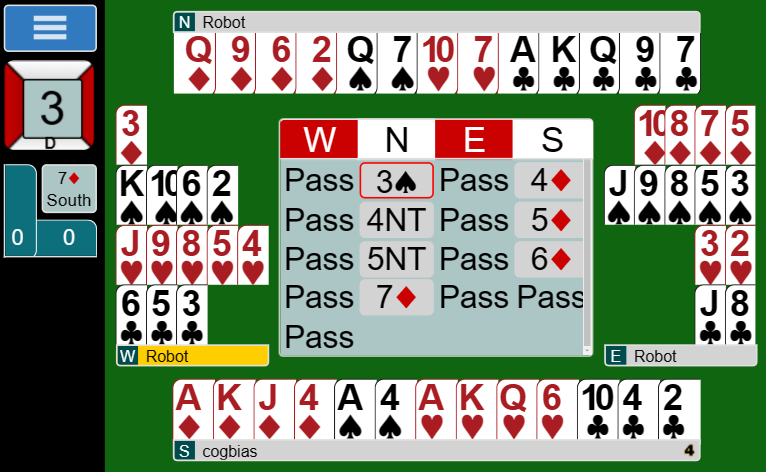
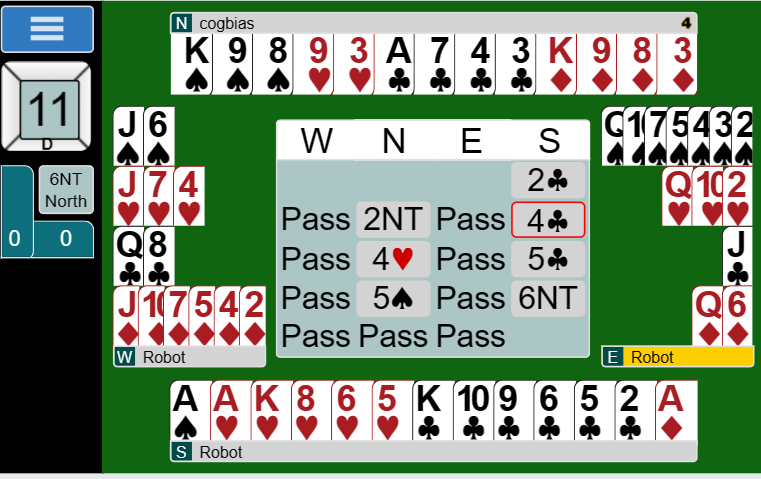
Gerber – No Trump Slam Try
In Gerber convention we alert by bidding 4!c. Here, we query Aces and Kings when trump suit has not been agreed upon but interest in slam has been shown.
The difference in no trump slam evaluation vis a vis a trump slam lies in the different nature of keycards. In trump suit all aces+trump king are 5 keycards whereas in no trump we must have all aces and all kings.
Gerber is used for a systematic slam evaluation when trump suit decision is inconclusive. Success will mostly lead to a No Trump slam but it can also happen that sign off takes place in a trump suit.
Keep in mind that 4NT over 1NT or 2NT, is natural and quantitative, inviting partner to bid 6NT as act of confidence in held hand. Here slam is proposed, purely, on hand strength. Whereas, Gerber and Blackwood follow a systematic approach.
4!c is conventional bid for Gerber. However, 4!c is a Cue Bid when it has been inferred that trump suit has been agreed.
When does Gerber apply? Here are some standard rules:
- An immediate 4!c response to 1NT or 2NT is Gerber.
- 4!c rebid by responder after 2!c Stayman initiation by him in previous bid, is Gerber.
| 4!c Gerber Alert Responses | Number of Aces |
| 4!d | 0 or 4 Aces |
| 4!h | 1 Ace |
| 4!s | 2 Aces |
| 4NT | 3 Aces |
| All other bids other than 5!c are sign offs | |
| Bids at level 5 are for Kings | |
| 5!c Gerber Alert Responses | Number of Kings |
| 5!d | 0 Kings |
| 5!h | 1 King |
| 5!s | 2 Kings |
| 5NT | 3 Kings |
| 6!c | 4 Kings |
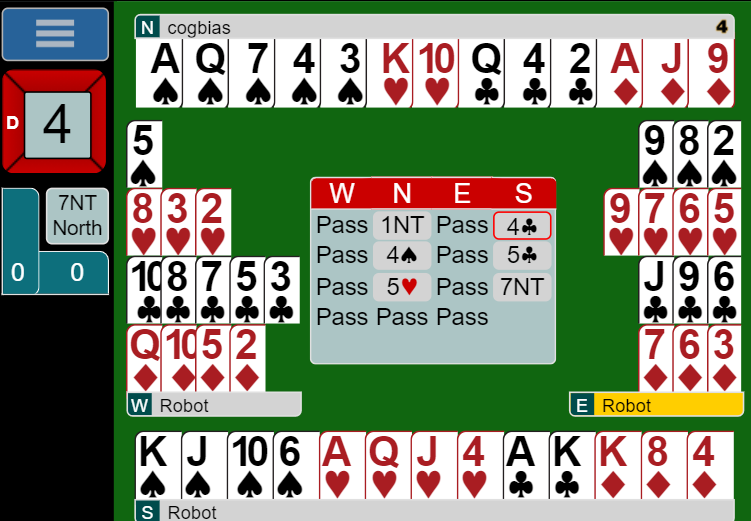
Lead Directing Double by opponent
opponent’s Double over all artificial conventions like In this case of Gerber, are Lead Directing. Opponent, here is requesting his partner to move opening lead in this suit.
Check out Below-Slam bid by using Gerber in a BBO round. Use button below to play this hand.
 Sunil Khanna